
USD/VND Exchange Rate Today (May 3): Diverging Trends Between Official and Black Markets
A Complex Currency Landscape Shaped by Global and Domestic Forces
The USD/VND exchange rate today reflects a nuanced and evolving financial landscape, where global macroeconomic pressures intersect with domestic monetary policies. On May 3, the Vietnamese foreign exchange market displayed a clear divergence between official banking rates and black market trading, highlighting underlying tensions in currency demand, investor sentiment, and economic expectations.
While commercial banks maintained relatively stable exchange rates due to regulatory oversight and holiday conditions, the informal market showed stronger fluctuations. This divergence is not merely a technical anomaly—it is a signal of deeper economic dynamics at play.
Understanding these movements is essential for investors, businesses, and policymakers navigating the increasingly interconnected global financial system.
Global Context: USD Weakness and Market Caution
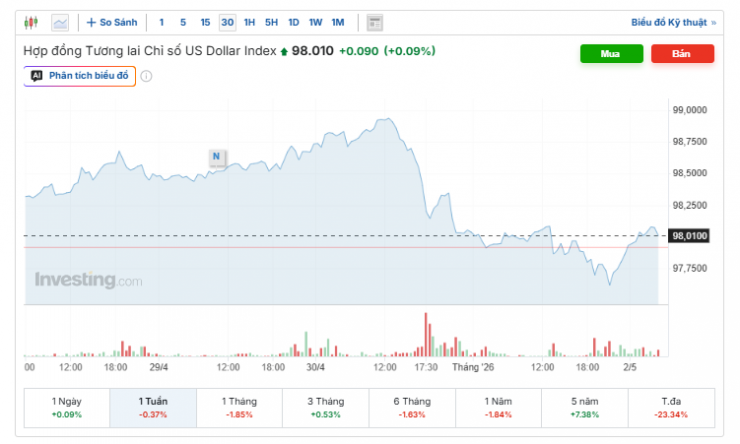
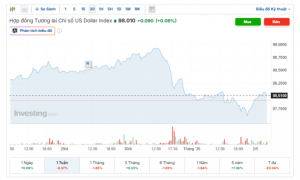
At the international level, the US dollar experienced a moderate decline, as reflected in the US Dollar Index (DXY), which fell to 98.01 points, down approximately 0.37% over the week. This decline suggests a cautious stance among global investors.
At the beginning of the week, the USD benefited from its traditional role as a safe-haven asset, supported by geopolitical tensions in the Middle East. However, this upward momentum proved unsustainable.
As the week progressed, investor sentiment shifted. Improved risk appetite led to a recovery in major currencies such as the euro (EUR) and British pound (GBP), reducing the relative attractiveness of the dollar.
By the end of the week, the market entered a phase of sideways consolidation, with no clear directional catalyst. This reflects a broader uncertainty as investors await key economic data and signals from policymakers.
The Role of the Federal Reserve and Interest Rate Expectations
A central factor influencing the USD is the monetary policy stance of the Federal Reserve. Markets continue to expect that the Fed will maintain higher interest rates for an extended period in order to combat persistent inflation.
However, a critical point is that much of this expectation has already been priced into the market. As a result, the USD is no longer receiving strong upward momentum from rate expectations alone.
Additionally, rising energy prices are contributing to ongoing inflationary pressures. This creates a difficult balancing act for central banks: tightening policy to control inflation without stifling economic growth.
This delicate equilibrium is one of the reasons why the USD is currently trading within a narrow range rather than experiencing a strong trend.
Currency Dynamics: Divergence Among Major Economies
The global currency market is also being shaped by diverging monetary policies among major economies.
- The euro and British pound have shown signs of recovery due to improving economic sentiment in Europe.
- The Japanese yen remains weak, largely due to the Bank of Japan’s continued accommodative policy stance.
- Commodity-linked currencies are experiencing mixed movements depending on energy price fluctuations.
These contrasting dynamics create a fragmented market environment, where no single currency dominates decisively. As a result, the USD’s strength is being challenged, though not significantly weakened.
Vietnam’s Official Market: Stability Through Regulation
Domestically, Vietnam’s official exchange rate system remains stable and tightly controlled.
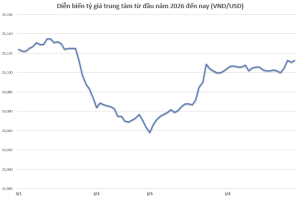
The State Bank of Vietnam set the central exchange rate at 25,113 VND/USD, marking a slight increase compared to earlier in the week. Commercial banks operate within a regulated band, ensuring limited volatility.
Major banks reported the following rates:
- Vietcombank: 26,108 – 26,368 VND/USD
- BIDV: 25,148 – 26,368 VND/USD
- Techcombank: 26,081 – 26,368 VND/USD
- ACB: 26,160 – 26,368 VND/USD
Due to the holiday period, banks largely maintained their quoted rates without significant adjustments.
This stability reflects the effectiveness of Vietnam’s monetary policy framework, which aims to minimize exchange rate volatility and protect economic stability.
The Black Market: A Reflection of Real Demand
In contrast, the black market tells a different story.
USD was traded at approximately 26,600 – 26,720 VND/USD, significantly higher than official rates. Compared to earlier in the week, this represents an increase of around 90–100 VND.
This gap highlights several important realities:
- Strong demand for USD among individuals and small businesses
- Limited access to foreign currency through official channels
- Speculative behavior driven by expectations of future depreciation
- Psychological factors influencing trading decisions
The black market often reacts more quickly to changes in sentiment, making it a useful—though unofficial—indicator of underlying economic pressure.
Why the Gap Exists Between Official and Informal Markets
The divergence between official and black market rates is driven by a combination of structural and behavioral factors.
First, the supply of USD in the official system is carefully managed by the State Bank, ensuring stability but limiting flexibility.
Second, demand for USD remains strong due to imports, overseas transactions, and precautionary savings.
Third, expectations about inflation and currency depreciation can lead to increased demand in informal markets.
Finally, the black market operates without regulatory constraints, allowing prices to adjust freely based on supply and demand.
Together, these factors create a dual-market dynamic that reflects both controlled policy and real-world economic behavior.
Short-Term Outlook: Range-Bound Movement
In the near term, the USD/VND exchange rate is expected to remain relatively stable within a narrow range.
There are currently no strong catalysts to drive a sharp appreciation or depreciation of the USD. Instead, the market is likely to continue reacting to incremental changes in global and domestic conditions.
Key factors to watch include:
- Upcoming US inflation data
- Federal Reserve policy signals
- Global geopolitical developments
- Capital flows into emerging markets
If these factors remain balanced, the exchange rate will likely continue to move sideways.
Long-Term Perspective: Structural Pressures Remain
Over the longer term, several structural factors could influence the USD/VND exchange rate:
- Persistent global inflation
- Shifts in global supply chains
- Changes in foreign direct investment (FDI) flows
- Vietnam’s trade balance and export performance
If inflation remains elevated and global uncertainty continues, the USD could retain its strength, putting upward pressure on exchange rates.
However, Vietnam’s strong economic fundamentals and proactive policy management provide a buffer against extreme volatility.
Implications for Businesses and Investors
For businesses and investors, understanding exchange rate dynamics is critical.
Import-dependent companies should consider hedging strategies to manage currency risk. Exporters may benefit from a stronger USD but must remain cautious about global demand fluctuations.
Investors should avoid speculative behavior driven by short-term movements and instead focus on long-term trends.
Diversification remains a key strategy in navigating uncertain currency environments.
Conclusion: A Market in Balance, Not in Crisis
The USD/VND exchange rate on May 3 reflects a market in delicate balance rather than instability.
While the divergence between official and black market rates highlights underlying demand pressures, the overall system remains stable thanks to effective regulation and policy management.
In a world marked by uncertainty, the Vietnamese foreign exchange market demonstrates resilience—adapting to global shifts while maintaining domestic stability.
For those closely watching the currency market, the message is clear: the real story is not in sharp movements, but in the subtle signals of a market carefully navigating between risk and opportunity.

Bài viết liên quan

Businesses to Self-Print Electronic Stamps for Alcohol and Tobacco from 2027: A Transformational Policy Shift in Vietnam

Employee Bonus After Selling a Company: A Powerful Story from Fibrebond