
Early Alzheimer’s Screening Could Prevent a Financial Crisis: Why Policy Must Catch Up With Innovation
Alzheimer’s disease is no longer just a medical challenge—it is rapidly becoming one of the most pressing economic threats facing modern healthcare systems. As populations age and the number of diagnoses continues to rise, the cost of care is placing unprecedented strain on families, healthcare providers, and government programs.
Recently, U.S. Health and Human Services Secretary Robert F. Kennedy Jr. emphasized a critical issue: the lack of widespread early Alzheimer’s screening. He described it as “regulatory malpractice,” pointing out that early detection and treatment can significantly delay the onset and progression of the disease.
This statement highlights a growing gap between what science can achieve and what public policy currently allows. While medical advancements are making early diagnosis more accessible and effective, healthcare systems remain largely focused on late-stage intervention—a model that is both medically outdated and financially unsustainable.
Why Early Alzheimer’s Screening Matters More Than Ever
Early Alzheimer’s screening is not just about identifying disease—it’s about changing outcomes. For decades, Alzheimer’s care has been reactive rather than proactive. Patients are often diagnosed only after symptoms become severe, limiting the effectiveness of available treatments.
However, recent innovations are transforming this approach. New diagnostic tools, including blood-based tests, can detect Alzheimer’s risk years before cognitive decline becomes noticeable. These advancements allow for earlier intervention, giving patients a better chance to slow disease progression.
Early screening also empowers patients and families to plan ahead, make lifestyle adjustments, and explore treatment options before the disease significantly impacts daily life. This shift from crisis care to preventive care represents a fundamental transformation in how Alzheimer’s can be managed.
The Growing Economic Burden of Alzheimer’s Disease
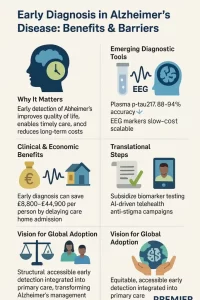
The financial implications of Alzheimer’s are staggering. More than 7 million Americans are currently living with the disease, and that number is projected to nearly double by 2060.
At the same time, the cost of care continues to rise. A semi-private room in a nursing home now averages over $112,000 per year, placing a heavy burden on families and public healthcare systems. Many patients require long-term care for years, further compounding the cost.
Medicare, one of the primary sources of funding for elder care, is also under pressure. Projections indicate that its hospital insurance trust fund could be depleted by 2033. Without significant changes, the system may struggle to support the growing number of Alzheimer’s patients.
Early Alzheimer’s screening offers a potential solution. By identifying the disease sooner and delaying its progression, patients can remain independent for longer, reducing the need for expensive long-term care.
How Early Detection Can Transform Patient Outcomes
The benefits of early Alzheimer’s screening extend far beyond cost savings. Patients who receive early intervention often experience a slower rate of cognitive decline. This means they can maintain their independence, relationships, and daily routines for a longer period.
In many cases, early treatment can add years of quality life. Patients may continue working, engaging socially, and managing their own care—outcomes that were previously considered unlikely once Alzheimer’s symptoms appeared.
Early detection also allows for better care planning. Families can prepare for future needs, access support services, and make informed decisions about treatment and living arrangements.
Ultimately, early Alzheimer’s screening shifts the focus from managing decline to preserving quality of life.
The Role of Innovation in Alzheimer’s Care
Medical innovation is opening new doors in the fight against Alzheimer’s. Blood-based diagnostic tests, advanced imaging technologies, and emerging treatments are revolutionizing how the disease is detected and managed.
These tools make it possible to identify Alzheimer’s in its earliest stages—sometimes even before symptoms develop. This represents a major breakthrough, as early-stage intervention is significantly more effective than treatment during advanced stages.
Healthcare leaders have recognized this potential. Advances in diagnostics are not just improving accuracy—they are making screening more accessible and scalable.
However, the full benefits of these innovations cannot be realized without policy changes. Regulatory barriers and slow adoption rates continue to limit access to these life-changing tools.
Why Current Policies Are Holding Back Progress
Despite rapid advancements in Alzheimer’s research, policy frameworks have not kept pace. Many healthcare systems still prioritize treatment over prevention, creating barriers to early diagnosis.
Regulatory delays, limited insurance coverage, and outdated guidelines prevent patients from accessing early screening tools. In a disease where timing is critical, these delays can have serious consequences.
When patients are diagnosed late, treatment options are less effective, and care costs are significantly higher. This cycle reinforces a reactive model that fails both patients and the healthcare system.
Aligning policy with innovation is essential to breaking this cycle.
Economic Benefits of Early Alzheimer’s Screening
The economic case for early Alzheimer’s screening is compelling. Research suggests that extending healthy life expectancy by just one year can generate an estimated value of $566,000 per person.
On a broader scale, investments in early detection and prevention could save the U.S. healthcare system up to $2.2 trillion annually by 2040. These savings come from reduced hospitalizations, lower long-term care costs, and improved patient outcomes.
Early screening also reduces indirect costs, such as lost productivity and caregiver burden. Families spend fewer resources on intensive care, and patients can remain active members of society for longer.
In short, early Alzheimer’s screening is not just a medical strategy—it is an economic necessity.
Policy Solutions: Bridging the Gap Between Innovation and Access
To fully realize the benefits of early Alzheimer’s screening, policymakers must take action. One proposed solution is the ASAP Act, which aims to integrate FDA-approved diagnostic tools into routine healthcare.
This legislation would make early screening more accessible and ensure that patients can benefit from the latest medical advancements. It also seeks to create clearer pathways for innovation, allowing new treatments to reach patients more quickly.
In addition, expanding insurance coverage for early screening and diagnostic tools would remove financial barriers for patients. Encouraging healthcare providers to adopt preventive care models can further support this transition.
By aligning policy with scientific progress, healthcare systems can deliver better outcomes at lower costs.
Public Support for Early Detection and Prevention
There is strong public support for early Alzheimer’s screening. Polling data shows that voters across political lines recognize the importance of prevention and early detection.
People understand that waiting until the disease reaches advanced stages is both costly and ineffective. Early intervention not only improves quality of life but also reduces the financial burden on families and the healthcare system.
This bipartisan support provides a unique opportunity for policymakers to implement meaningful reforms.
The Urgency of Acting Now
The gap between innovation and policy is not just a theoretical issue—it has real consequences for millions of people. Every year of delay means more patients are diagnosed too late, more families face financial hardship, and healthcare systems become increasingly strained.
The tools for change already exist. Advances in diagnostics and treatment have made early Alzheimer’s screening both feasible and effective.
What is needed now is the political will to implement these solutions.
Conclusion: A Path Forward for Alzheimer’s Care
Early Alzheimer’s screening represents one of the most promising opportunities to improve patient outcomes and reduce healthcare costs. By shifting from a reactive to a proactive approach, we can transform how this disease is managed.
The science is clear: early detection works. The economic benefits are undeniable. And public support is strong.
Now, it is up to policymakers to act.
Aligning healthcare policy with medical innovation will not only improve lives—it will help prevent a looming fiscal crisis. The question is no longer whether early Alzheimer’s screening is necessary, but how quickly it can be implemented.
The future of Alzheimer’s care depends on the decisions made today.

Bài viết liên quan

Businesses to Self-Print Electronic Stamps for Alcohol and Tobacco from 2027: A Transformational Policy Shift in Vietnam
USD/VND Exchange Rate Today (May 3): Diverging Trends Between Official and Black Markets