
Federal Deficits Persist Despite Revenue Growth: What the Latest CBO Report Reveals About America’s Spending Problem
Federal deficit 2026 remains a major concern as government spending continues to outpace revenue growth. Despite higher tax collections, the gap between income and spending is still widening.
The latest report from the Congressional Budget Office (CBO) delivers a clear and sobering message: even as federal revenues rise significantly, the United States continues to run massive budget deficits. The numbers reveal a deeper issue—one that goes beyond short-term fluctuations and points to a long-term structural imbalance in federal fiscal policy.
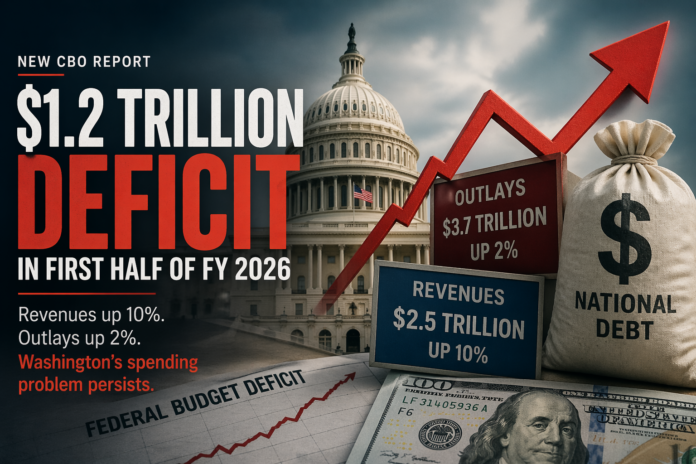
According to the CBO’s Monthly Budget Review for March 2026, the federal government recorded a deficit of $1.2 trillion in just the first half of fiscal year 2026. While this figure represents a slight improvement compared to the previous year, it remains alarmingly high. More importantly, it highlights a fundamental truth: increased revenue alone is not enough to close the gap between government income and spending.
Understanding the Federal Deficit in 2026
The federal deficit occurs when government spending exceeds revenue. In the first six months of fiscal year 2026, the government collected approximately $2.5 trillion in revenue but spent $3.7 trillion. The result was a $1.2 trillion deficit—an enormous imbalance in a relatively short period.
Although revenues increased by $223 billion, or about 10 percent, spending also rose by $84 billion. This dynamic illustrates why deficits persist: even when income grows, expenditures continue to expand, often at a pace that offsets any gains.
This pattern is not new, but it is becoming increasingly difficult to ignore. The scale of current deficits suggests that the problem is structural rather than cyclical.
Revenue Growth: Taxes and Tariffs Drive the Increase
One of the key highlights of the CBO report is the strong growth in federal revenue. Total receipts reached $2.5 trillion, driven primarily by increases in income taxes, payroll taxes, and tariff collections.
Tariffs, in particular, experienced a dramatic surge. Collections from customs duties nearly quadrupled compared to the same period in the previous year, increasing by $123 billion. This sharp rise reflects recent policy changes that have expanded the use of tariffs as a revenue source.
While higher revenue may appear to be a positive development, the composition of that revenue raises important concerns. Tariffs function as taxes on imports, which can lead to higher prices for consumers and increased costs for businesses. Over time, this can distort markets and reduce economic efficiency.
Meanwhile, corporate tax revenues declined significantly. Receipts from corporate income taxes fell by $45 billion, or 28 percent, indicating potential shifts in business activity, tax policy, or broader economic conditions.
Together, these trends suggest that while revenue is increasing, it is not necessarily becoming more stable or sustainable.
Federal Spending Continues to Rise
Despite gains in revenue, federal spending continues to climb. In the first half of fiscal year 2026, total outlays reached $3.7 trillion—an increase of $84 billion compared to the previous year.
The primary drivers of this growth are the government’s largest mandatory spending programs: Social Security, Medicare, and Medicaid. Combined, these programs saw an increase of $109 billion, reflecting both a growing number of beneficiaries and rising costs per person.
- Social Security spending increased by $42 billion
- Medicare spending rose by $34 billion
- Medicaid spending grew by $33 billion
These increases are not temporary. They are the result of long-term demographic and economic trends, including an aging population and rising healthcare costs.
As more Americans retire and rely on these programs, spending will continue to rise unless significant reforms are implemented.
Rising Interest Costs Add to the Burden
Another major factor contributing to the deficit is the growing cost of servicing the national debt. As the total debt increases and interest rates remain elevated, the government must allocate more resources to interest payments.
In the first half of fiscal year 2026, net interest outlays increased by $33 billion. This rise is driven by both the larger debt burden and higher long-term interest rates.
Unlike many other types of spending, interest payments do not provide direct services or benefits to the public. Instead, they represent a cost of past borrowing, reducing the government’s ability to invest in other priorities.
As debt continues to grow, interest costs are expected to consume an even larger share of the federal budget.
A Structural Spending Problem
The most important takeaway from the CBO report is that the United States does not have a revenue problem—it has a spending problem.
Even with a 10 percent increase in revenue, the deficit remains deeply entrenched. This indicates that the gap between income and expenditures is driven primarily by structural factors rather than short-term economic conditions.
Month-to-month data reinforces this conclusion. In March 2026 alone, the federal government recorded a deficit of $163 billion, underscoring the persistent nature of the issue.
Rising tax collections, whether from income taxes or tariffs, are consistently outpaced by the growth in federal obligations. Without changes to spending policies, deficits are likely to remain high or even increase in the future.
The Role of Entitlement Programs
Entitlement programs are at the center of the federal spending challenge. These programs are designed to provide benefits to eligible individuals, and their costs are largely determined by factors such as population size and healthcare inflation.
As the U.S. population ages, more people become eligible for Social Security and Medicare. At the same time, advances in medical technology and rising healthcare costs increase the average cost per beneficiary.
This combination creates a powerful upward pressure on spending that is difficult to control without policy changes.
While these programs play a critical role in supporting millions of Americans, their current growth trajectory raises serious questions about long-term sustainability.
Why Revenue Increases Alone Are Not Enough
It is tempting to view rising revenue as a solution to budget deficits. However, the CBO report demonstrates that this approach has clear limitations.
When spending continues to grow, additional revenue is quickly absorbed. This creates a cycle in which higher taxes or new revenue sources fail to produce meaningful reductions in the deficit.
Moreover, relying heavily on certain types of revenue—such as tariffs—can have unintended economic consequences. Increased costs for imports can lead to higher prices, reduced competitiveness, and potential disruptions in global trade.
A balanced approach to fiscal policy must address both sides of the equation: revenue and spending.
The Long-Term Fiscal Outlook
The trends highlighted in the CBO report point to a challenging future for U.S. fiscal policy. Without significant reforms, deficits are expected to remain high, and the national debt will continue to grow.
This trajectory poses risks not only to the economy but also to the government’s ability to respond to future crises. High levels of debt can limit flexibility, increase borrowing costs, and reduce confidence in fiscal stability.
Addressing these challenges will require difficult decisions, including potential changes to entitlement programs, tax policies, and spending priorities.
A Call for Structural Reform
The latest CBO report makes one thing clear: the United States faces a structural fiscal imbalance that cannot be solved by revenue increases alone.
While rising revenues provide temporary relief, they do not address the underlying drivers of spending growth. Without meaningful reform, deficits will persist, and the long-term outlook will remain uncertain.
Policymakers must confront the reality that sustainable fiscal policy requires a comprehensive approach—one that balances revenue with responsible spending.
The numbers are clear. The question now is whether action will follow.

Bài viết liên quan

Businesses to Self-Print Electronic Stamps for Alcohol and Tobacco from 2027: A Transformational Policy Shift in Vietnam
USD/VND Exchange Rate Today (May 3): Diverging Trends Between Official and Black Markets